
Optimising the Photoshop Express User Journey
A data-informed redesign of key touchpoints across the Photoshop Express journey to reduce friction, improve conversion, and drive user engagement.
Product Design . Growth & Optimization . Design Lead
Overview
I led an initiative to identify opportunities to improve the Photoshop Express user funnel, from the initial launch experience through to editing and sharing.
The work brought together behavioural data, competitive analysis, and experience evaluation to understand where users encountered friction and where we could create a more intuitive path to the product's core value. Working closely with Product and Data Science, I translated these insights into a set of opportunities and design hypotheses to guide future optimisation efforts.
Rather than treating each drop-off as an isolated interaction problem, we looked at the complete journey to understand how individual decisions across the experience influenced user progression.
The Challenge
The journey from launching Photoshop Express to completing a meaningful creative action involved multiple steps—including onboarding, authentication, permissions, discovering the editing experience, and exporting or sharing.
Each step introduced an opportunity for users to disengage before experiencing the value of the product.
How might we simplify the journey, reduce unnecessary friction, and help users reach their first meaningful creative moment sooner?
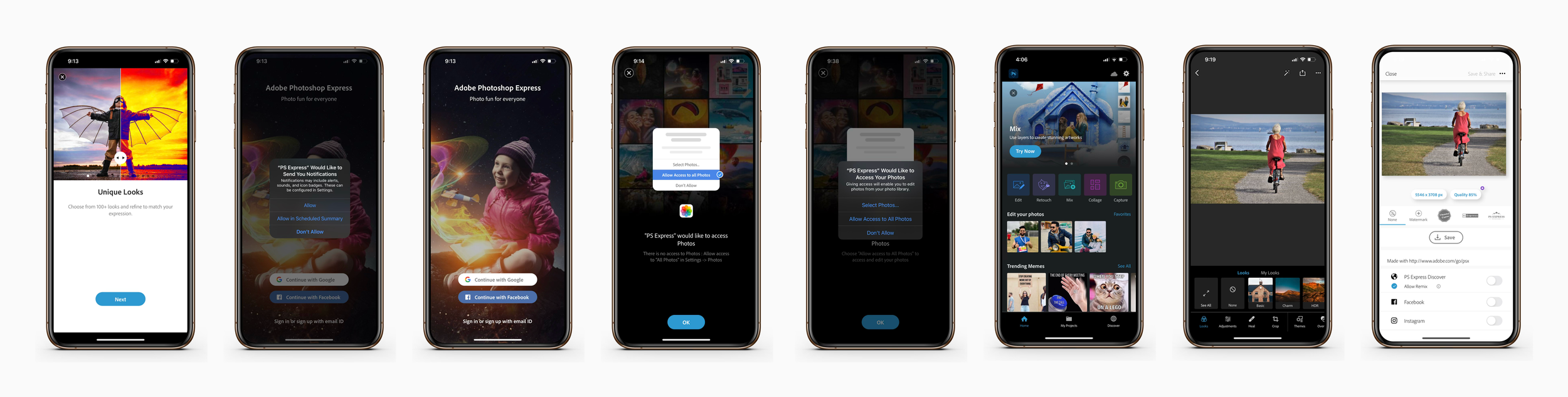
PsX funnel from discovery to share
01 / Understanding the Funnel
We partnered with Product and Data Science to dive into behavioural data and understand progression across the activation journey.
The analysis helped us identify key drop-off points and evaluate how different interactions—from the initial front door to photo permissions, image selection, editing, and sharing—contributed to the overall experience.
The funnel highlighted opportunities across the journey, with particular attention to helping users progress from entering the product to engaging with creative tools and completing an action that demonstrated product value.
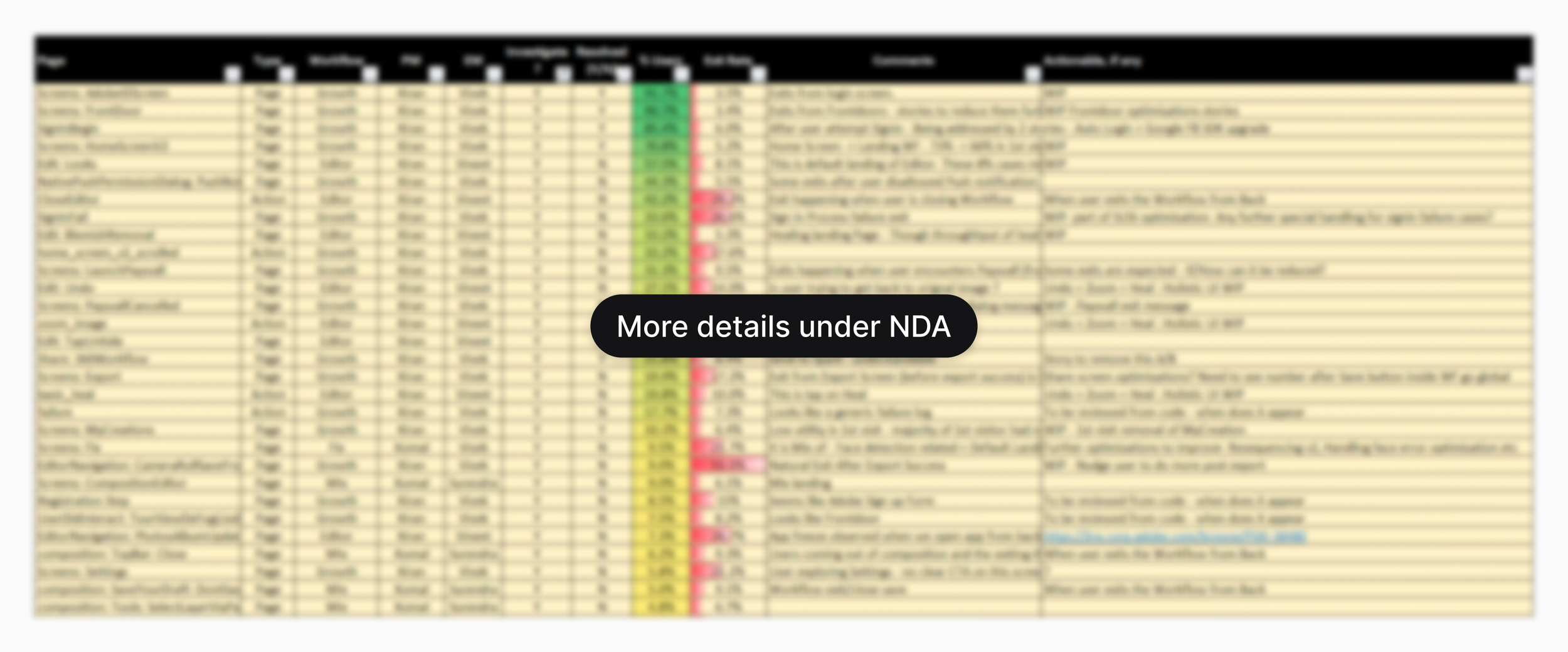
Collaborate with product and data science team to deep dive into the “data lake” and drive brainstorming on potential opportunity areas / hypothesis
02 / Looking Beyond Our Own Experience
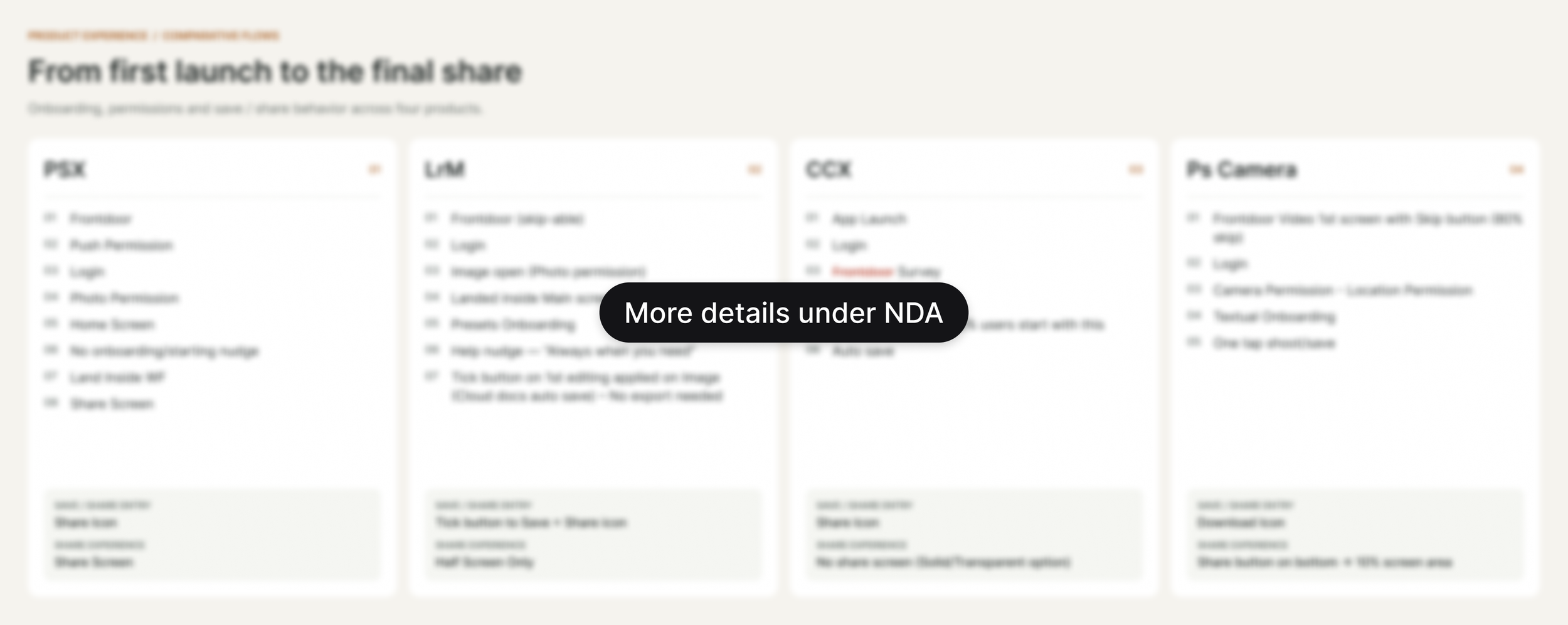
To understand the friction more holistically, we conducted a competitive analysis across products in the creative editing space.
We evaluated experiences including Lightroom, Photoshop Express, CCX, and PS Camera, looking at how they approached:
Front-door and onboarding experiences
Authentication and login
Home-screen discovery
Photo permissions and image selection
Editing workflows
Export and sharing
The analysis helped us understand not only how other products structured their journeys, but also where they were creating friction—and where simpler patterns could offer a better experience.
We approached the exercise from the perspective of a user, advocating for clarity, ease of progression, and a more seamless creative journey.
03 / Synthesising the Opportunities
Combining the behavioural analysis with competitive insights allowed us to move from identifying drop-offs to defining specific opportunities for improvement. These opportunities formed the foundation for a focused set of hypotheses that could be prioritised, explored, and evaluated.
Reduce unnecessary entry points
Could we simplify or skip parts of the front-door experience without negatively impacting retention?
Optimise authentication
Could the login experience be streamlined to help users progress with less friction?
Create a clearer first action
Once users reach the home screen, what is the most valuable action we should encourage them to take?
04 / From Insights to Design Hypotheses
We translated the opportunity areas into a series of design questions to guide exploration and future experimentation.
Rather than prescribing solutions immediately, we focused on understanding the potential impact of changing individual steps in the journey.
Hypothesis 01 / Can we remove unnecessary front-door steps?
Explore whether users can reach the core experience more directly, while understanding the potential implications for engagement and retention.
Hypothesis 02 / Can we simplify login?
Identify opportunities to reduce the friction associated with authentication and help users move forward.
Hypothesis 03 / What should users do first?
Revisit the home-screen experience to establish a clear and intuitive first action.
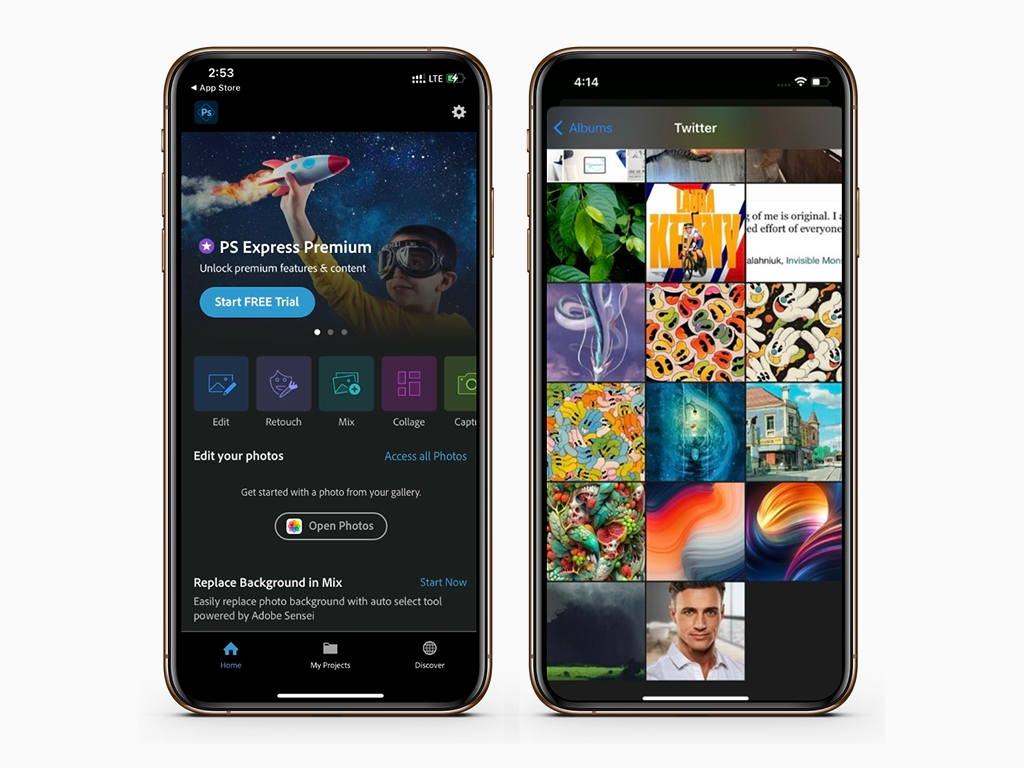
01 / Leverage the native iOS gallery
We explored using the native iOS photo gallery to make image selection more familiar and reduce friction associated with the permission experience.
This approach allowed us to reconsider the interaction through established platform conventions rather than introducing unnecessary complexity.
Guide users towards impactful tools
How could we help users discover and engage with tools that create a compelling first experience?
Improve the sharing experience
How could we simplify the share sheet, make the primary action more obvious, and help users realise the value of their creation sooner.
Hypothesis 04 / How can we help users discover impactful tools?
Introduce more contextual guidance and onboarding to help users understand and engage with the tools that create value.
Hypothesis 05 / How can we make sharing more effective?
Simplify the sharing experience, clarify the primary action, and help users complete the journey while reinforcing the value of their creation.
05 / Rethinking Permission Experiences
One of the key opportunities identified was reducing friction around photo permissions.
Users were encountering permission requests before they had fully understood the value of the experience. We explored alternative approaches that could help users engage with the product while making permission requests feel more contextual and purposeful.
Design Principle : Don't make users unlock the experience before they understand its value.
By exploring alternative entry points into the creative experience, we aimed to make the journey feel more accessible, contextual, and user-driven.
Using native iOS gallery
02 / Introduce sample and free images
We also explored making sample images available within the experience.
This would allow users to begin exploring creative tools without immediately needing to provide access to their personal photo library—removing a potential barrier between product entry and experiencing value.
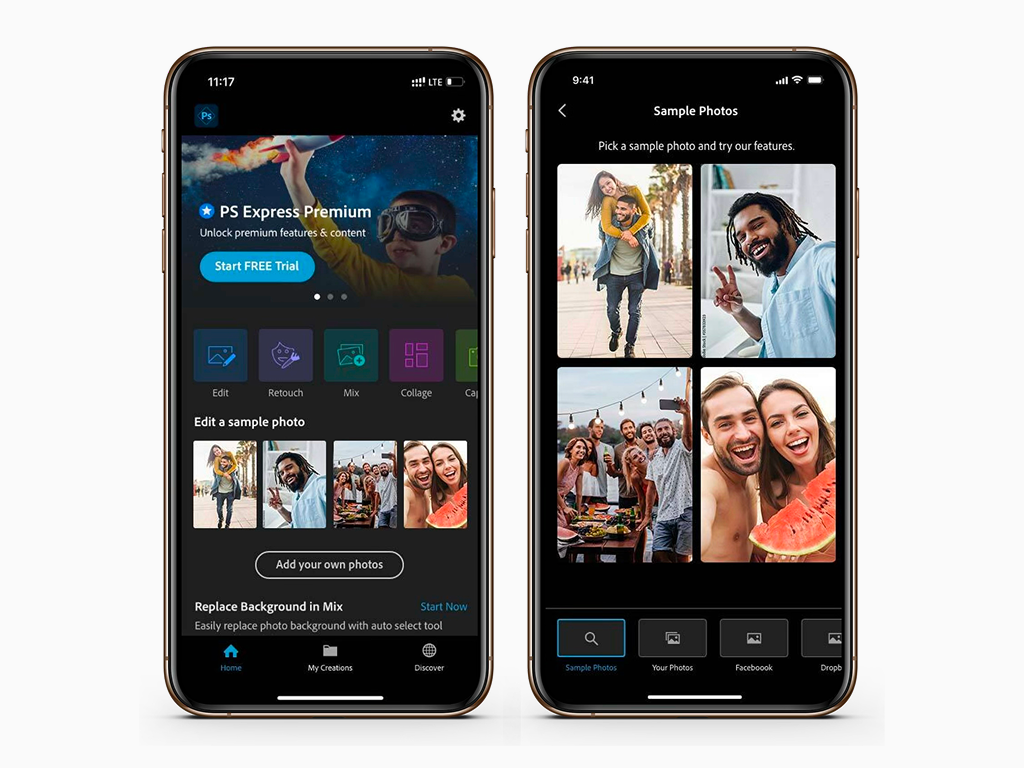
Sample / Free images to remove locked doors
06 / From Strategies to Deliveries
The initiative followed a structured progression from strategic understanding to design exploration and delivery. This structure helped connect insights with actionable design work and create alignment across Product, Data Science, and Design.
01 / Strategy : Define the vision and opportunity
Analyse the activation journey
Conduct competitive analysis
Identify friction and opportunity areas
02 / Roadmap & Backlog : Develop hypotheses across opportunity areas
Break opportunities into user stories and feature considerations
Prioritise based on potential user impact
Align design priorities with product direction and effort
03 / Design & Delivery : Scope design efforts
Explore and evaluate solutions
Drive design sign-offs
Iterate based on data and feedback
Share learnings with larger teams
07 / Outcomes
The initiative established a data-informed view of the Photoshop Express activation journey and identified opportunities to improve progression across key stages of the funnel.
It translated behavioural analysis and competitive benchmarking into a focused set of design hypotheses spanning onboarding, authentication, home-screen discovery, tool engagement, permissions, and sharing.
The work provided a foundation for prioritising experience improvements and aligning stakeholders around a more frictionless path to creative value.
08 / Reflection
The biggest takeaway was that activation is rarely defined by a single screen. It is the cumulative effect of decisions across an entire journey.
By looking at the funnel holistically, we were able to shift the conversation from individual UI improvements towards the broader experience—questioning when to ask users for permissions, what value to demonstrate first, how to guide discovery, and how to help users complete meaningful actions.
The exercise reinforced the importance of bringing behavioural data and design judgment together to identify not just where users drop off, but why—and where the greatest opportunities lie.